
Wow, what an exciting time to be in business. 2025 was an unprecedented year, marked by significant changes and uneven contours driven by numerous competing and compelling technological advances. 2026 is already shaping up to be another edge-of-your-seat spectacle.
This year will be JSDMC’s sixth full year in business, and I can think of only one other period when so many competing forces have been applied to businesses. That period being the late 1800s, when electricity changed the world. Streets were alight at night in NYC, and you could travel by electric streetcar for the first time from Allston (the western edge of Boston) to downtown Boston in 30 minutes: A trip that previously took a day on horseback. Today we’re seeing similar shifts in efficiency. LLMs are reducing tasks that would take a day to complete to five-minute tasks.
Of course, there’s more to this story. Hold on to your hats as I take you through things you need to know. There’s a lot to cover, so let’s get started.
A Wider Perspective
I want to start this article with a wide aperture before delving into the digital marketing trends, which I suspect most of you have come here for. These predictions will help you understand the coming changes in digital marketing.
AI is the next wave
Yes, AI is the next wave. This isn’t hard to predict, but most people miss that this isn’t the final form of the product or the industry’s final form. We’re still in the middle of a wave.
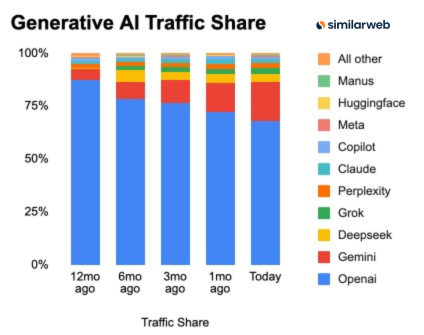
Google is seeing a surge in market share lately, and while I can’t discredit big-G, I don’t see the current industry form as the final stable state of a mature industry. As outlined by Howard Marks in “Is it a Bubble?” and by Kai Wu’s excellent industry analysis, “Surviving the AI CapEx Boom,” we’re seeing unprecedented investment in AI capacity. However, as history has shown in the railroad and fibre optic booms, the winners were not the builders who built capacity before demand, but the infrastructure companies that supported them.
One of the biggest issues at play and reasons I believe the industry hasn’t settled yet is the need for vast amounts of data and energy to train the models. While all the majors are working on this problem, the solution isn’t in our current approach to training LLMs. For example, consider the vast number of books ChatGPT needed to ingest to become coherent. A human doesn’t need this amount of data. Simpler systems will need to be built to reach AGI, and it’s unlikely to come from any incumbent, as they are entrenched in their ways. Whoever solves the training problem will win the industry.
Computing will change
We haven’t seen a major shift in how computers are built in decades. The technology has been around for almost 60 years (Apple II launched in 1977). Additionally, there are two major players: Apple and Microsoft. It’s conceivable that new AI technologies could change how operating systems function. This doesn’t begin to account for other factors, such as advances in chips, let alone quantum computing.
Point-and-click methods will transition to prompt-based actions, not like DOS command-line interfaces, but like integrated solutions seen in Minority Report and Iron Man. This change will be more incremental in its impact, but expect a deeper integration of computing into your life.
Expect smaller companies to thrive
Given the fact that AI is the next wave, it’s not a far bet to see leaner companies thriving in the future. Large companies will shrink, and new organizations will be smaller. This is especially true for human-intensive industries such as software development, consulting, and, to an extent, law and healthcare. You can expect other service-based industries to adjust as well. To me, it’s conceivable that Starbucks could fully automate its service and delivery, as we’re seeing hints of with its mobile pickup cafes.
One space I’m excited about is MicroSaaS. These are traditional SaaS companies without the bloat. These are companies run by a lean team or a solopreneur, where automation and AI handle the vast majority of the work. Large companies have the resources to adopt these tools, but their inertia will make implementation difficult. New enterprises have the advantage.
Training senior professionals
One impact of AI that many people are missing (or ignoring) is that junior roles will be eliminated, leaving a skills gap. Without junior roles, how do we expect to train the next level of senior professionals needed to create strategy and optimize our AIs? I believe mentoring and internships will play a role, but this still leaves a wide chasm. However, one benefit is that this may push new professionals into jobs where AI has less impact. Jobs such as nursing and the trades are expected to grow, which is much needed.
Digital Marketing Trends to Watch
Modern web browsers
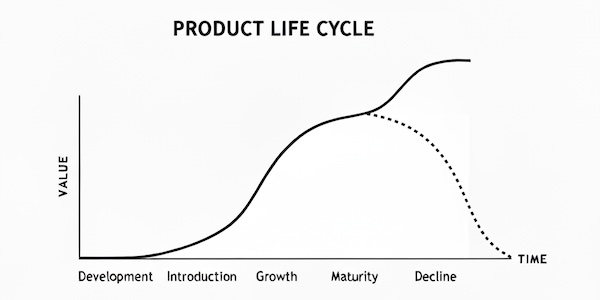
Web browsers haven’t changed markedly since Tim Berners-Lee launched the WorldWideWeb in 1991. If we’re to follow product cycles alone, we’re due for a change in how we access the internet. However, the product lifecycle isn’t the only force of change. AI has swept into everything we do today. Expecting the web browser to remain immune to AI adoption and product enhancements would be naive.
We’re seeing an influx of new AI-powered browsers on the market. To name a few: OpenAI launched ChatGPT Atlas, The Browser Company created Dia, Perplexity developed Comet, and Google released Disco in beta. The basic premise is that you use an LLM to browse. Plug in what you want to do, and the browser will handle the searching, collating, and summarizing for you. It can even book your next haircut appointment.
The video above shows me using the Comet browser to book a haircut. It did a solid job, but there were a few missteps along the way. I don’t see this as an issue. After all, GPS navigation was poor when it first went public. Now, it’s impossible to get somewhere without it.
The key consideration is that there will be an intermediary between the user and your business; optimizing your website for that intermediary is the top priority. While Google has long served as an intermediary, agentic browsing takes this to the next level. This will change how websites are built because LLMs are text guzzlers. While LLMs can see images and videos, processing those formats is resource-intensive (i.e. expensive). Text-based formats will be prioritized. This will shepherd in an era of minimalistic websites. We’re seeing this already with LLM Info pages.
Agentic shopping
Humans like to buy stuff, and companies like to make money. As long as that remains the case, it’s obvious that shopping is the next evolution for AI. In fact, just this week, Google announced Universal Commerce Protocol (UCP) and Microsoft added Copilot checkout. In this world, you simply tell the LLM what you want to buy, and it’ll find relevant products, guide you through the purchase decision, and even make the purchase for you, as you saw with my haircut appointment.
For businesses, this has significant implications. As I highlighted above, this means an intermediary will recommend products. Whether you’re in that recommendation depends on whether the LLM knows about your business and the products you sell. Optimizing your website for agentic shopping will become as critical as getting your website online in 2010. Those who miss the wave will suffer.
I believe a wave is the right analogy because a wave builds over time. Businesses that jump on the wave early will enjoy the momentum of an early surge and avoid the struggle of trying to catch a fast-moving body of water. The wave analogy also captures the idea that it’ll be hard to pick the best wave from the start. You need to have a keen eye for how they develop in your area.
Evolution of Search
If the agentic browser dominates, we can carry that forward to how a search engine, or more appropriately, an answer engine, will work. People will have fewer choices and be prescribed a course of action. The “10 blue links” will transform to zero-click answers. This will compel people to trust the LLM.
One side effect of how we build LLMs is that they can become biased. This is because they are designed for engagement, and responses will become tuned to what you like. Try asking ChatGPT the same question with both positive and negative sentiment and see what happens. While LLMs will save countless hours of research, the diversity of results will degrade. For this reason, I recommend that people clear their search histories periodically to ensure fresh results surface. For agencies and consultants, it’s best to do client research in separate accounts.
Beyond bias, let’s now turn to industry.
Several businesses have already been affected by Google’s shift to AI answers (see NerdWallet). With the rise of agentic shopping and the introduction of protocols such as UCP, I expect a larger share of businesses to be affected. E-commerce is the first natural target.
Google has long marked e-commerce and now has it set in its crosshairs. If UCP becomes the standard, it will ensure people shop on a Google surface, reducing website traffic to businesses. For companies like Amazon and Walmart that bring in additional revenue from retail media, shopping directly with Google could significantly impact their bottom line.
Additionally, I predict that airlines and hotels will see a shift in traffic with the rollout of agentic shopping. This will be especially true once people can purchase a ticket via a Google surface like Google Flights or Google Hotels. Although UCP states that brands can opt for their own checkout flow via an iframe, this still means travellers won’t be exposed to the brand as they were in the past. It’ll be fleeting compared to visiting the IHG or Air France websites.
Wrapping up
Search will continue to evolve beyond a direct answer. As each platform seeks visitor growth and monetization, this will benefit users in the near future, but, as Google’s founders highlighted, ad-supported platforms tend to degrade the experience over time to prioritize advertisers. Additionally, LLMs face several issues that need to be addressed. We’ll likely see new tools and methods for building LLMs that will provide the answers. For now, keep looking forward. It’s going to be another exciting year.