
Traffic is getting harder to earn, not because people stopped searching, but because AI keeps answering their questions before they ever click a link. If your content still looks like everyone else’s, it’s being pushed to the sidelines.
The brands still winning traffic are doing something different. They’re creating content that AI can’t easily replace, that Google can’t instantly summarize, and that audiences actually want to engage with. The kind of content that earns links, attention, and repeat visits instead of fighting for scraps in a zero-click SERP.
In this article, you’ll discover the four content types that are driving outsized traffic right now and why they’re more resilient to AI than traditional blog posts. You’ll see how interactive tools, proprietary insights, and media formats create leverage that most marketers overlook, plus how to decide what topics to create so your effort actually pays off.
This approach comes from hands-on experience helping brands in competitive industries grow traffic in a search landscape shaped by LLMs and shifting Google features. If you’re serious about building content that still performs in 2026, you’re in the right place.
4 content types that drive traffic
Digital PR and link bait
Calculators
Calculators make life easier for people. There are many opportunities to create these interactive content pieces across a wide variety of industries. In fact, there’s an entire website, Omni Calculator, built around calculators.
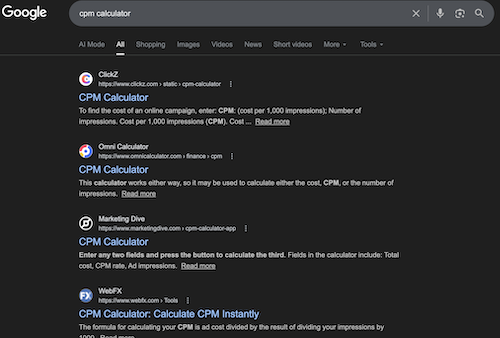
What makes calculators powerful today is that LLMs like ChatGPT can’t build them on the fly. For example, if you’re looking for a CPM (cost per thousand impressions) calculator, Google is going to give you 10 blue links. It’s not going to fill up the SERP (Search Engine Results Page) with a calculator or a bunch of other SERP features. This gives your content a chance to win.
Here are a couple of examples from our clients
Now, just because Google isn’t likely to show a calculator doesn’t mean you can’t use an LLM to build one. Spend an hour vibe-coding, and you’ll have a powerful tool your audience will love.
Proprietary research
One way to win in business is to develop a proprietary strategy. The same goes for content. Proprietary research, by definition, is unique to you and your business. But, again, what we love about this type of content is that it’s hard for LLMs to reproduce. In fact, LLMs will be more likely to include your information because it’s unique. And, when you make that research valuable to your audience, you’ll earn big traffic.
The best research starts with a fun idea. For our insulation client, we recently thought about how much it would cost to insulate the Home Alone house. Once the idea emerged, we set out to research what it would actually cost by checking the home’s details on Zillow and using our client’s estimating tools to build the case. The result was a hilarious piece we can promote year after year whenever Kevin McCallister appears on your TV screen.
Videos
Video is another differentiator. Most businesses find the medium hard to produce, but in reality, with a bit of effort, you can share your ideas through motion.
We like using the COPE (Create Once Publish Everywhere) method when developing content. This means that when you have a blog article, also consider how you can produce a video from the same content. You can also go the other way around and create a video that also becomes a blog article. You’ll likely find that one direction works better for you (i.e. video -> article vs article -> video). The main idea is to squeeze as much content from a single idea.
By way of example, in our recent post about digital marketing trends, I created a video of me booking a haircut using the Comet browser. This gives people something interactive on the page, but also provides an opportunity to promote my business on another channel.
Podcasts
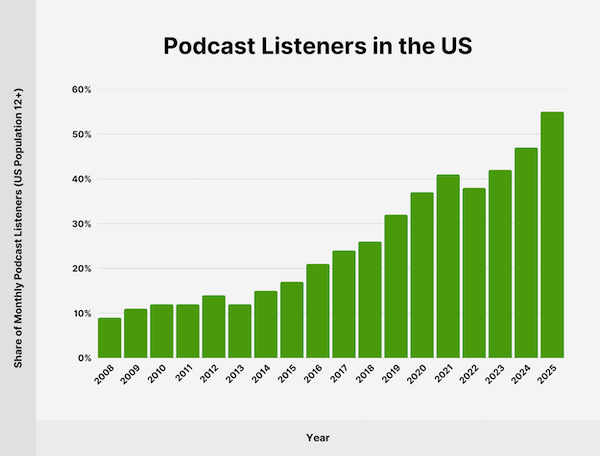
We’ve become an earbud society, which means podcasts are on the rise and the trend looks to continue. Aside from the audience growth, podcasting can increase the number of quality backlinks to your website.
Admittedly, podcasting can be a challenge, especially when it comes to getting the right equipment, talent, and editing skills to produce a high-quality show. In fact, we wanted to do a podcast for one of our clients, but their team hadn’t the time or the inclination to do one on their own. We turned to NotebookLM to help us create a quality show that can be easily replicated. While podcasting isn’t the only tactic we used, our client’s website traffic has tripled.
How do you know what to write
Determine your ICP (Ideal Customer Profile)
Your ICP is the foundation of your marketing plan and, quite frankly, this deserves an entire post, but I’ll give you the gist of it now.
The first step is to visualize and put on paper your ideal customer. That is, if you could wave a magic wand and choose a person to be your customer, what would they look like? Who would they be?
For example, at JSDMC, we work with travel, health & wellness brands. That means one of our ideal customer profiles is in the travel industry. You should get even more specific about who that person is. The more detail you identify, the easier it will be to create content for that customer.
To determine your ICP, think about all the customers you’ve served already. Consider their qualities. Things like are they organized? Do they communicate effectively? How big are they? Answering these questions will help you see what traits are good and which ones you’ll want to avoid. Continue along these lines until you arrive at a clear picture of your ideal customer.
Once you have that clear picture in your mind, you need to get it on paper. Write down all of the details of your ideal customer. We recommend giving this person a name so you can remember and visualize this customer whenever you need to.
Know your customer
The next step after you have your ICP is to go deeper into knowing your customer. You want to build knowledge about who this person is, what questions they ask about your product and service, and how they consume content. These aspects will help you tailor your content strategy to your ICP, making it more effective.
Topic research
With a better understanding of your ideal customer, you can turn to topic research. The best way to do this is to put on the customer hat. Think about their problems and challenges. What do they want to accomplish? How can they get that done? You will find your topics from the answers to these types of questions.
For example, if I want to target hotel brands looking for a digital marketer, one of their top problems is getting more direct bookings. From that, I can now build a list of topics that help hotels get more direct bookings.
Content best practices
Focus on CTR: Write killer headlines
The advent and continued push of zero-click search means headlines have become more important than ever. Zero-click search makes click-through rates vastly more important for traffic generation. This is because the trend toward answer-first search results makes it rare for websites to appear in the SERP. You want that link clicked since there are only a few opportunities.
To get a high rank and good CTR, you need two things: a front-loaded keyword and a reason to click (i.e., your differentiator). The best place to look for examples is news headlines. You’ll want to determine your headline style. By that, I mean how factual vs click-baity you want to get. For example, here’s a New York Times headline, “Netflix Revamps Its Warner Bros. Bid, Seeking to Thwart Paramount,” and here’s a New York Post headline, “‘Baffled’ Super Bowl coach eviscerates Bills GM over ‘f–king raise’ after firing coach.” While both examples tell you the article’s topic and spike curiosity, the New York Post example is more emotional.
Want help with your headlines? Try our Headliner GPT that uses your content to identify the primary keyword and searches Google to generate SEO-optimized headlines.
Keep your content fresh
Who wants to eat a rotten apple? Nobody.
Google and LLMs love fresh content. But just like food, some topics have a longer expiration date. This is known as Topic Needs Freshness (TNF). The first thing you want to do is run a Google search for your primary keyword or topic. Then look at the top results. Are the top results recently published or recently edited? If so, your topic needs freshness.
Freshening your content is simple. Update any dates you’ve used in the content to the current year. Check for any outdated stats, insights, and links. Once the main content is up to date, update the introduction. These changes should be enough to trigger Google to take another look at your post. The key is to ensure your content stays relevant in a changing world.
Frequently Asked Questions about Content Types
What role does E-E-A-T play in helping proprietary content outperform AI-generated summaries?
E-E-A-T helps proprietary content outperform AI-generated summaries by emphasizing first-hand experience, deep topical expertise, author authority, and strong site trustworthiness. Search engines prioritize content that demonstrates Experience, Expertise, Authoritativeness, and Trust, which AI summaries often lack due to their generic and synthetic nature.
How can smaller teams prioritize high-leverage content formats without increasing production costs?
Smaller teams can prioritize high-leverage content formats by repurposing existing assets, focusing on evergreen topics, and using structured templates for scalable production. Formats like comparison posts, expert roundups, and how-to guides offer strong ROI without requiring new resources or large budgets.
Can AI-driven tools still support content ideation without commodifying the content itself?
AI-driven tools can support content ideation without commoditizing content by generating topic ideas, identifying gaps, and analyzing trends, while leaving the execution to human expertise. When creators infuse originality, experience, and insight, the final content retains uniqueness and avoids becoming generic.
How should internal linking and site architecture change when content is built around tools and media instead of blog posts?
When content is built around tools and media instead of blog posts, internal linking should connect features, use cases, and support content. Site architecture must prioritize hubs for tools or media types, ensuring clear navigation paths, contextual relevance, and authority signals around each asset.
Wrapping up
Like most things, some content gets more mileage than others. As a digital marketer, part of your job is to find those leverage points. In this post, we covered the 4 best types of content to produce in 2026. These content types drive more traffic than anything else. What’s more? They are shielded from the brunt of AI. To boot, audiences love them, too.
Looking to take your content strategy to new heights? Work with a digital marketing consultant to help you plan your next move.