
Search traffic is shifting fast. One day you are optimizing for blue links. Next, AI tools answer your customers’ questions before they even click your site. If your content is not built for both, you are invisible.
AEO vs SEO is not a battle. It is an evolution.
Traditional SEO rewards depth, structure, internal links, and a strong user experience. AEO, or Answer Engine Optimization, rewards clarity at the sentence level, consistency in facts, and content that AI systems can easily extract and cite. Ignore either one and you risk losing traffic overnight.
In this article, you are going to learn how to:
- Write content that ranks in traditional search and gets cited by AI tools
- Apply the Three Cs: Complete, Clear, and Consistent, to increase AI visibility
- Structure answers so LLMs can extract and surface them instantly
- Use formatting and structured data to win featured snippets and voice results
- Measure AEO success without sacrificing SEO performance
This is not theory. It is based on real-world search strategy, semantic structure principles, and how modern LLMs retrieve and predict information using search-backed systems.
If you want your brand to show up in search results and inside AI-generated answers, keep reading. The rules have changed, but the opportunity is bigger than ever.
AEO vs SEO Content writing
When writing for AEO vs SEO, you need to consider a lot of the same characteristics. So, before you go any further, don’t throw out your past learnings. Good writing is still good writing.
Creating content for SEO means covering topics completely. This can be done at the page level or the site level. SEO also demands that you consider how pages relate to one another through backlinks and link building. Visitor experience is also a critical part of creating content for search engines. Pages that are sticky and easy to use will keep people on them longer, which has an advantage for your brand.
Writing for AEO on the other hand, is more focused on the sentence level. Providing content that is to the point and logical wins. And, because LLMs are prediction machines, you need to pay attention to the way you explain common concepts. Consistency matters.
Three Cs of Content Development for LLMs
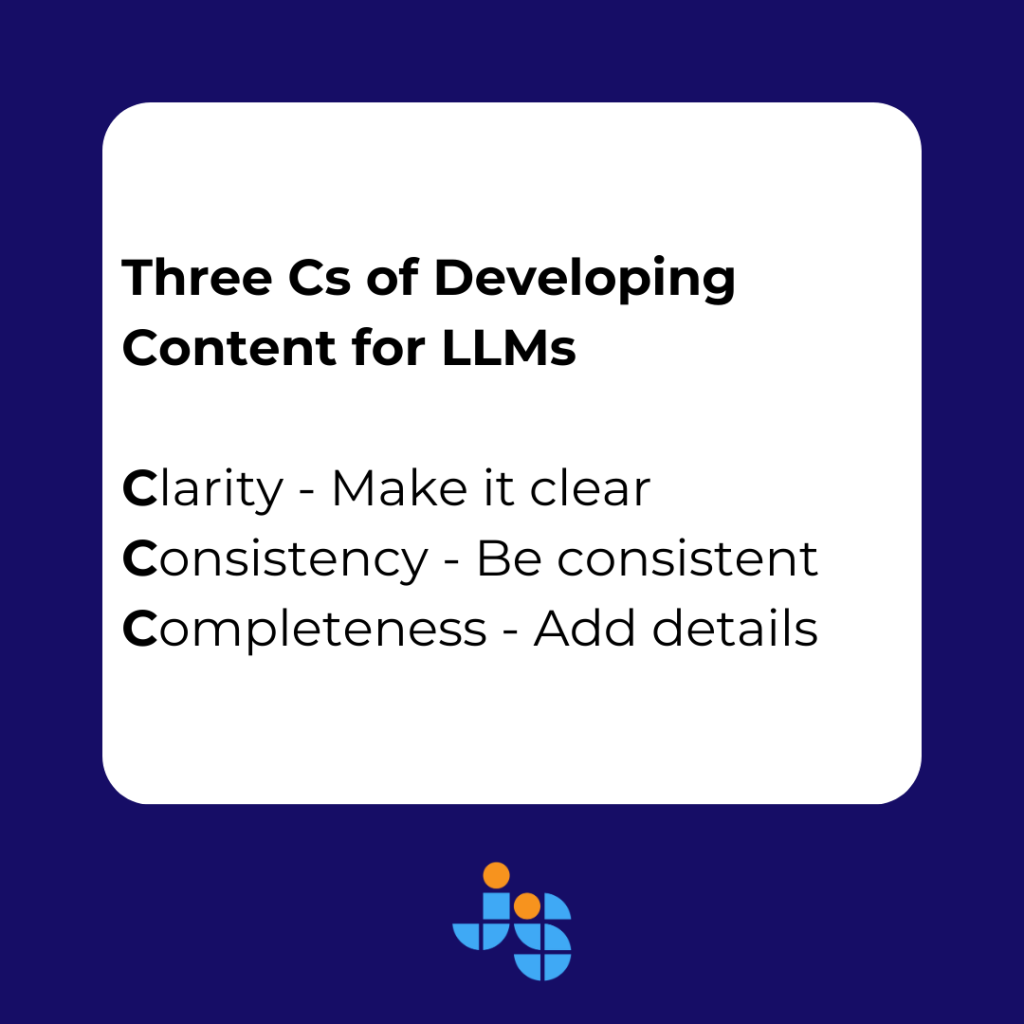
Creating content for LLMs as part of an AEO (Answer Engine Optimization) strategy isn’t much different than creating an SEO strategy. In fact, we want you to consider both as you create content. Traditional search still matters, and you don’t want to see your traffic disappear overnight. Also, LLMs rely heavily on search to augment their training with current information, meaning they use traditional search to surface relevant information. With that in mind, here are the keys to creating content that LLMs cite and mention.
Complete
Your content must be complete. This means covering a concept fully. This doesn’t mean you need to cover an entire topic; it helps with SEO, but you do need to include various angles on a concept.
A concept is complete when its content addresses both the explicit and implicit aspects of the concept. That means going over the who, what, when, where, how and why. For example, if you’re writing a “how-to” article, don’t just say “install the software”; tell me where to download it, the system requirements, the cost, and how long it might take to complete the project.
Watch out for filler, though. This concept isn’t about length; it’s about giving your readers everything they need to satisfy the reason they are accessing your content.
Clear
LLMs appreciate clarity and conciseness. Clear writing favours familiar, direct words over buzzwords, jargon and abstract concepts. Also, vague words like “soon” or “later” should be avoided, as they are less specific.
Here are some examples:
Instead of: “We will leverage synergies to optimize outcomes.”
Use: “We will work together to improve our results.”
Instead of: “This metric is suboptimal.”
Use: “This metric is too low and needs to increase by 15%.”
There are a couple of ways you can make your writing clearer. First, use the active voice. Passive writing is longer, more abstruse, and messier. It’s hard to read a passive sentence.

The next thing to consider is the semantic triple. This model, while not attributed to a single inventor, originated in Ross Quinlan’s 1968 “semantic memory” paper, and was later refined by the W3C working group that proposed the Resource Description Framework (RDF) model as a foundation in linguistics and AI in the 1990s.
As the name suggests, the semantic triple consists of three parts: subject, predicate, and object. For example, “Bob – knows – Bill.” This is a simple sentence, but you can see how tightly packed with meaning it is.
Content that is logical and shorter, but still complete, will be picked up more reliably.
Consistent
Most importantly, if you want an LLM to accurately cite your brand, you need to be consistent about the facts you use. For example, if your business sells a product at a certain price, you need to state that price consistently across all of your properties. The same goes for brand messages. Use your comms consistently wherever you can.
How does structured data support both SEO and AEO strategies?
Structured data supports SEO by helping search engines understand page content and display rich results such as FAQs, reviews, and product snippets. Structured data supports AEO by enabling voice assistants and AI systems to extract precise answers for featured snippets and conversational responses, increasing visibility across search and AI platforms.
How should content formatting differ when optimizing for AEO?
Format content for AEO by using clear question-based headings, concise 40–60 word answers, bullet points, and structured data markup. Place the direct answer immediately below each heading. Use simple sentences, definitions, and lists to help AI systems extract precise responses for voice search and generative engines.
What role does topical authority play in AEO compared to SEO?
Topical authority strengthens SEO by improving rankings across clusters of related keywords. Topical authority strengthens AEO by increasing the likelihood that AI systems select a source for direct answers and citations. Build topical authority by publishing comprehensive content hubs, interlinking related articles, and covering subtopics with depth and consistency.
How can brands measure success in AEO?
Brands measure AEO success by tracking featured snippet wins, AI-generated answer citations, voice search visibility, and answer-driven traffic. Monitor impressions and click-through rates in Google Search Console, track brand mentions in AI tools, and measure increases in non-branded organic traffic and conversions tied to question-based queries.
Does long-form content still matter in an AEO-driven strategy?
Long-form content still matters in an AEO-driven strategy because it builds topical authority and supports multiple extractable answers within one resource. Create comprehensive 1,500–3,000 word pillar pages that cover core topics, then structure sections with clear questions and concise answers to improve AI selection and citation.
Wrapping up
Search is no longer just about ranking pages; it is about becoming the source that both search engines and AI systems trust to answer questions. When your content is complete, clear, and consistent, it becomes easier for traditional search engines to rank and for large language models to extract, summarize, and cite. Brands that understand this shift will not only maintain their organic visibility but expand it across AI assistants, voice search, and generative results.
The Three Cs provide a practical framework for adapting your content strategy to this new environment. By covering concepts thoroughly, writing with precision, and maintaining consistent facts across your digital presence, you create content that works across both SEO and AEO ecosystems. This dual approach ensures your information can rank in search results while also being selected as a trusted answer in AI-generated responses.
If you want to future-proof your content strategy and ensure your brand is visible in both search results and AI answers, consider working with an experienced AEO consultant who understands how modern search systems retrieve, interpret, and surface information. The sooner your content is built for this new landscape, the stronger your advantage will be.